
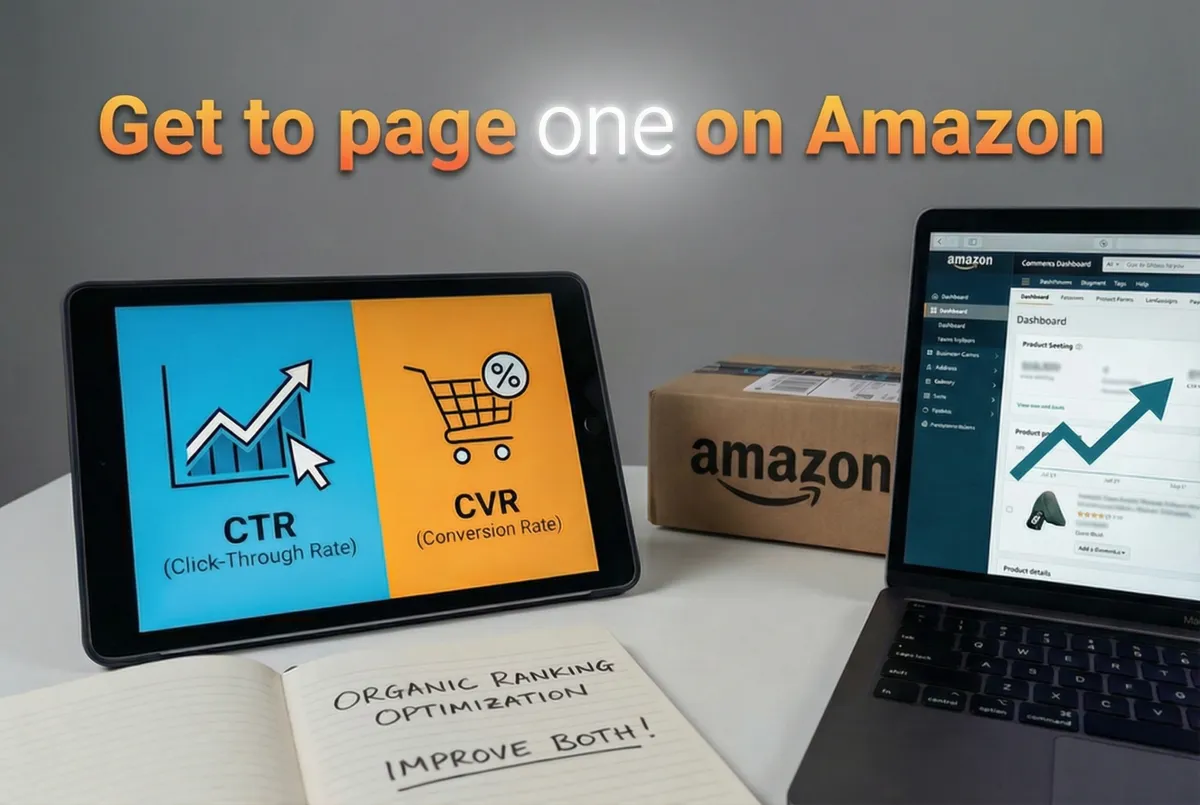
Amazon CTR vs. CVR: The Two Metrics That Control Your Organic Ranking (And How to Fix Both)
Amazon CTR vs. CVR: How to Control Your Organic Ranking
Most Amazon sellers obsess over the wrong things.
They tweak their backend keywords. They add more bullet points. They wonder why their ranking isn't moving — while completely overlooking the two signals Amazon's algorithm actually weighs more than anything else: click-through rate and conversion rate.
If your listing isn't climbing in organic search, the answer is almost always sitting in one of those two numbers. This post breaks down exactly what CTR and CVR mean, how Amazon uses them to determine your rank, and the specific levers you can pull to improve both.
How Amazon's Organic Ranking Algorithm Actually Works
Amazon's algorithm (often called A9 or A10) has one job: show the products most likely to generate a purchase for any given search query. It's not trying to reward the best product. It's trying to predict the most profitable outcome for Amazon.
To do that, it watches two things above everything else: how often shoppers click your listing when it appears in search results (CTR), and how often those shoppers actually buy once they land on your page (CVR).
A listing that gets clicked frequently and converts well tells Amazon's algorithm one thing: shoppers want this product. Then, Amazon responds by ranking it higher, which drives more traffic, which produces more data, which reinforces the ranking. It compounds.
A listing that gets ignored in search results, or gets clicks but fails to convert, sends the opposite signal. Amazon pulls back your visibility. Your rank drops. Your sales slow. And most sellers never identify the real cause.
Key insight: Amazon doesn't rank listings based on how good your product is. It ranks them based on how well your listing performs with CTR and CVR as the primary performance signals.
What Is Amazon Click-Through Rate (CTR) and Why It Matters for Organic Rank
Click-through rate is the percentage of shoppers who see your listing in search results and choose to click on it. If your listing appears 1,000 times in search and 30 people click, your CTR is 3%.
Amazon uses CTR as a measure of relevance and appeal. A high CTR tells the algorithm that your listing is connecting with searchers. That means your title, your main image, your price, and your star rating are collectively compelling enough to earn the click over every competitor on the page.
A low CTR tells Amazon the opposite. Even if your product is genuinely better, if shoppers aren't choosing to click you in search results, the algorithm treats you as less relevant and adjusts your visibility accordingly.
What shoppers see before they click:
Main image — the single biggest driver of CTR on Amazon
Title — specifically the first 80 characters, which is all that displays on most devices
Price — relative to competitors on the same page
Star rating and review count — social proof at a glance
Badges — Best Seller, Amazon's Choice, and similar signals that build instant trust
If your CTR is underperforming, the fix is almost always in one of these five elements. And the most impactful place to start is almost always the main image.
How to Improve Amazon CTR: What Actually Moves the Needle
1. Upgrade Your Main Image
Your main image is competing against every other listing on the search results page at the exact same moment. Shoppers make the click decision in under a second.
Use a clean white background that makes your product pop
Show the product at the largest possible size within the frame
If your product has a key differentiator that's visible, show it prominently
Study the top 3 competitors in your search results — then design your image to stand out, not blend in
2. Rewrite Your Title for the First 80 Characters
Most shoppers never read past the first line of a title. Put your highest-impact keywords and your strongest differentiator in the first 80 characters, not buried in a long string of secondary terms.
3. Earn Your Badges
Best Seller and Amazon's Choice badges dramatically lift CTR because they do the trust-building work for you in search results. These aren't gamed. They're earned through sales velocity and strong performance metrics.
What Is Amazon Conversion Rate (CVR) and How It Affects Your Ranking
Conversion rate is the percentage of shoppers who visit your listing and make a purchase. If 100 people land on your page and 12 buy, your CVR is 12%.
The average Amazon conversion rate across all categories sits between 10–15%. If you're converting above that benchmark, Amazon's algorithm rewards you with more visibility. If you're converting below it, your ranking will stagnate regardless of how much you spend on PPC.
CVR is where the real money is made—and the real ranking leverage lives. Because once a shopper clicks into your listing, you have their full attention. Everything on that page either builds the case for the purchase or creates doubt that sends them back to the search results.
What drives conversion on a listing page:
Image gallery — lifestyle images, infographics, and detail shots that show the product in context
Bullet points — benefits-first copy that answers objections before they're raised
A+ Content — brand story and product detail that builds trust and reduces return risk
Reviews and ratings — both the overall score and the content of recent reviews
Price — relative to perceived value, not just competitor pricing
Fulfillment method — Prime eligibility and delivery speed have a measurable impact on conversion
How to Improve Amazon Conversion Rate: The Highest-Leverage Fixes
1. Audit Your Image Gallery
Your main image gets the click. Your image gallery closes the sale. The highest-converting listings use their gallery to tell a story: who this product is for, what problem it solves, how it's different, and what it feels like to own it.
Lead with lifestyle imagery that shows the product in use
Add infographic images that call out key features and dimensions
Include a comparison image if you have a clear advantage over competitors
Address the top 2–3 objections from your reviews in visual form
2. Rewrite Your Bullet Points Around Objections
Most bullet points describe features. The best bullet points pre-empt the doubts that would otherwise send a shopper to a competitor. Go through your 1- and 2-star reviews and your competitors' reviews and build your bullet points around the questions shoppers are asking before they buy.
3. Build Your Review Base Strategically
Nothing kills conversion faster than a thin review count or a recent string of negative feedback. Getting to 50+ reviews with a 4.3+ average rating is the threshold most listings need to convert at a competitive rate.
CTR and CVR Together: How the Two Metrics Compound Your Organic Rank
Here's why both metrics matter and why you can't fix one while ignoring the other.
A high CTR with a low CVR tells Amazon that your listing is attractive in search but disappointing in person. Shoppers click expecting one thing and find another. Amazon interprets this as a relevance problem and will begin limiting your visibility over time.
A high CVR with a low CTR means your listing converts well when people find it — but not enough people are finding it. You're leaving ranking velocity on the table because you can't generate enough click data to signal relevance at scale.
The listings that climb fastest and hold their rank are the ones where both metrics are working together: a search result that earns the click, and a listing page that earns the sale. That combination sends Amazon a clear signal, which will in turn respond by feeding you more traffic, which generates more data, which holds and builds your rank.
The goal isn't to optimize CTR or CVR in isolation. It's to build a listing that earns the click AND closes the sale. This is what Amazon's algorithm is measuring, and this is what separates the top organic results from everything beneath them.
The Sellers Who Rank (And Stay Ranked) Understand This
Most Amazon sellers treat ranking like a keyword problem. They stuff titles. They load backend search terms. They wonder why it's not working.
The sellers who build durable organic rank understand that keywords get you indexed, but CTR and CVR are what actually move you up. Keywords tell Amazon what searches you're eligible for. CTR and CVR tell Amazon whether you deserve to rank for them.
Get both right, and your rank compounds. Get one wrong, and you plateau, no matter how much you spend on ads to compensate.
Understanding this is the difference between managing a listing and building a brand that ranks on its own.