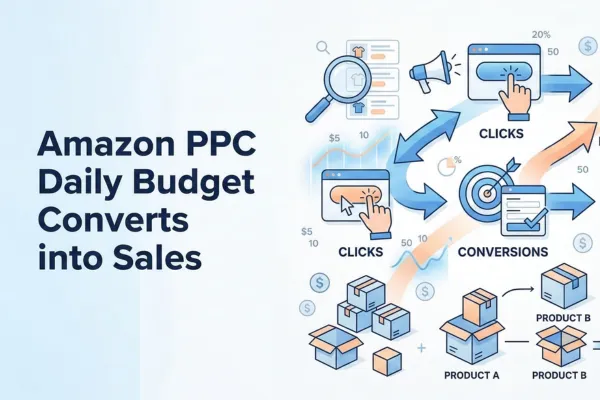
Amazon PPC Strategy: How Much Should Beginners Spend?
When you launch your first product on Amazon, advertising isn't optional — it's the engine that gets your listing in front of buyers. But for most beginners, deciding how much to spend on Amazon PPC feels like guesswork. Spend too little and your product stalls. Spend too much and your margins disappear before you've made a meaningful sale.
This guide breaks down realistic Amazon PPC budgets for new sellers, explains how the cost system works, and gives you a practical framework for launching your first product without wasting money.
Advertising is only one part of the total investment required to launch a product. If you're calculating your full startup budget, see our complete guide on how much it costs to start an Amazon FBA business, which breaks down inventory, shipping, and advertising expenses in detail.
Why Amazon PPC Is Necessary When Launching a New Product
Amazon's search algorithm rewards listings that already have sales, reviews, and click history. New listings have none of these — which means organic ranking takes time you may not have.
Amazon PPC (Pay-Per-Click) advertising solves this by placing your product directly in front of shoppers searching for relevant keywords. Every click is a chance to generate a sale, and every sale signals to Amazon's algorithm that your listing is worth ranking higher.
Without advertising at launch, a new product often sits invisible on page five or beyond — where virtually no one looks. PPC is the most reliable way to generate early momentum, gather sales data, and begin climbing organically. It isn't a permanent expense, but it is an essential one at launch.
Typical Amazon PPC Budgets for Beginners
Your launch budget depends on your product category, competition level, and how aggressive you want your launch to be. Here are the three most common approaches new sellers take:
Most first-time sellers land in the standard range. A 30-day budget of $750–$1,500 is enough to generate meaningful data, gather early reviews, and test which keywords are driving conversions — without burning through your full startup capital in the first month.
How Amazon PPC Costs Work
Amazon PPC operates on a cost-per-click (CPC) auction system. When a shopper searches a keyword, Amazon runs an instant auction among all sellers bidding on that term. The seller with the winning bid gets the ad placement, but only pays when a shopper actually clicks the ad — not just for the impression.
Your CPC is influenced by:
Competition — More sellers bidding on a keyword drives prices up
Keyword relevance — Highly relevant keywords often convert better, improving your ad efficiency
Bid amount — You set a maximum bid; Amazon charges just above the second-highest bid in the auction
Ad placement — Top-of-search placements typically cost more than product page placements
Average CPCs vary widely by category. Budget categories like household basics may see CPCs of $0.40–$0.80, while competitive niches like supplements or electronics can push $1.50–$3.50 per click or higher. Research your category's average CPC before finalizing your budget.
How Much Should You Spend Per Day on Amazon PPC?

A practical rule of thumb for new sellers: set your daily PPC budget at roughly 10–15% of your target daily revenue.
If your product sells for $30 and your goal is 5 sales per day ($150 in revenue), a daily ad budget of $15–$22 is a reasonable starting point. This keeps your Advertising Cost of Sale (ACOS) in a manageable range while generating enough traffic to gather useful data.
Here are realistic daily budget benchmarks by launch stage:
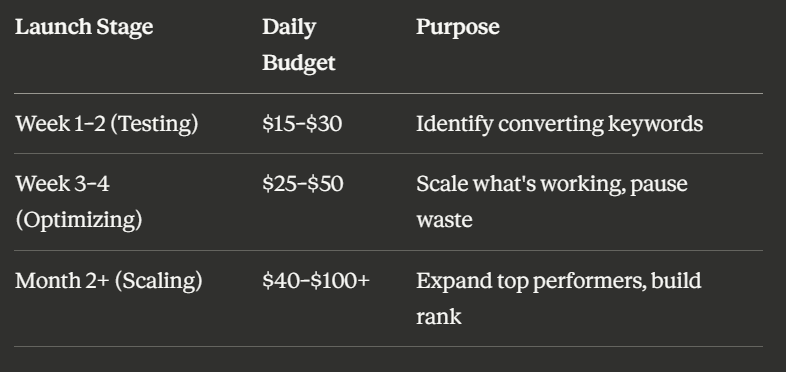
Never set your daily budget so low that your ads run out of funds by midday. Amazon rewards consistent ad activity — campaigns that stop and start due to budget caps lose data continuity and algorithmic momentum.
Common PPC Budget Mistakes Beginners Make

Knowing where other sellers go wrong can save you significant money early on.
Spending too little to generate data. A $5/day budget might sound safe, but it generates so few clicks that you can't make informed decisions about which keywords to keep or cut. You need statistically meaningful data to optimize.
Spreading budget across too many campaigns at once. New sellers often launch five or six campaigns simultaneously. This fragments your budget and leaves each campaign under-funded. Start with two to three focused campaigns and expand from there.
Not setting negative keywords. Without negative keywords, your ads appear for irrelevant searches and drain your budget on clicks that will never convert. Review search term reports weekly and add irrelevant terms as negatives.
Pausing campaigns too early. PPC takes time to optimize. Sellers who pause after two weeks because ACOS looks high miss the learning period every campaign goes through before performance stabilizes.
How to Reduce Amazon PPC Costs
Reducing PPC costs isn't about spending less — it's about spending smarter.
Target long-tail keywords. Specific phrases like "stainless steel camping mug 16oz" have lower CPCs than broad terms like "camping mug," and often convert better because buyer intent is more defined.
Use exact and phrase match types. Broad match campaigns discover new keywords but burn budget on irrelevant clicks. Shift budget toward exact and phrase match once you've identified your best performers.
Optimize your listing first. A high-converting listing (strong images, clear title, compelling bullet points) means more of your clicks turn into sales — directly lowering your ACOS without touching your bids.
Run scheduled bid adjustments. Review your campaign data to identify which days and hours produce the best conversions, and reduce bids during low-converting windows.
How PPC Costs Affect Amazon Profit Margins
Understanding ACOS (Advertising Cost of Sale) is essential for managing profitability. ACOS is calculated as:
ACOS = Ad Spend ÷ Ad Revenue × 100
If you spend $150 on ads and generate $500 in sales from those ads, your ACOS is 30%.
More important than your actual ACOS is your break-even ACOS — the maximum you can spend on advertising before a sale produces zero profit. To calculate it:
Break-Even ACOS = Profit Margin % (before ad spend)
For example: if your product sells for $35 and your total costs (product, shipping, Amazon fees) are $22, your pre-ad profit is $13 — a 37% margin. That means any ACOS below 37% keeps you profitable. Above that, each ad-driven sale costs you money.
During launch, running at or slightly above break-even ACOS is often acceptable — you're buying sales history and reviews, not just immediate profit. But you should always know your number before you start spending.
Amazon PPC Budget Example for a New Product
Here's a realistic worked example for a beginner launching a private label product:
Product details:
Selling price: $32.99
Cost of goods + shipping: $9.50
Amazon FBA fees: $7.20
Pre-ad profit per unit: $16.29
Break-even ACOS: ~49%
Month 1 PPC plan:
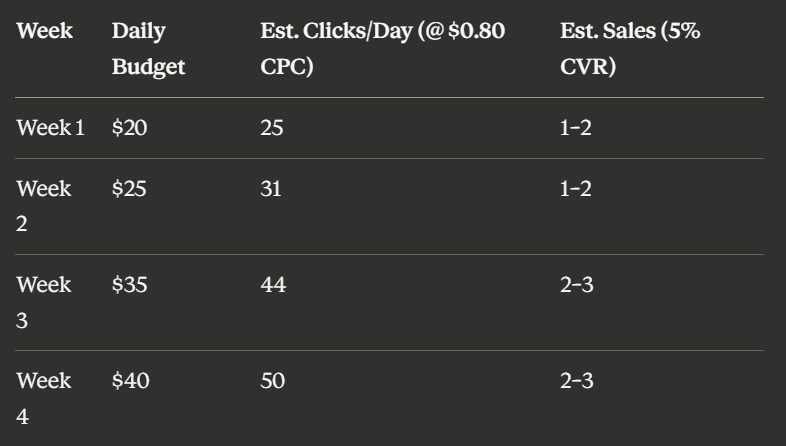
Total Month 1 ad spend: ~$840 Estimated sales generated: 60–80 units Estimated ad-attributed revenue: ~$2,000–$2,600 Resulting ACOS: ~32–42% — within break-even range
By the end of month one, this seller has real sales data, early reviews building, and a shortlist of profitable keywords to scale in month two.
🎯 Planning Your First Amazon Product Launch?
Before launching a product, experienced sellers usually estimate inventory costs, advertising budgets, and expected margins together — not separately.
If you're evaluating product ideas and want a structured way to calculate demand, competition, and real launch costs, this Amazon product research and profitability workbook walks through the same framework sellers use to validate products before placing their first order.
It can help you estimate realistic startup budgets, including inventory, shipping, and PPC, so you launch with clearer expectations.
Conclusion: Amazon PPC Strategy
There's no single correct Amazon PPC budget — but there is a smart approach. For most beginners launching a private label product, a 30-day budget of $750–$1,500 provides enough runway to generate data, test keywords, and build early sales momentum without overextending financially.
The goal in your first month isn't to be profitable on ad spend alone. It's to learn what works, build the sales history Amazon's algorithm rewards, and position your listing to rank organically over time. Treat your PPC budget as an investment in that foundation — and measure it against your break-even ACOS, not just the dollar amount leaving your account.
Plan your budget before launch, know your numbers, and commit to at least 60–90 days of consistent optimization before drawing firm conclusions about your product's potential.