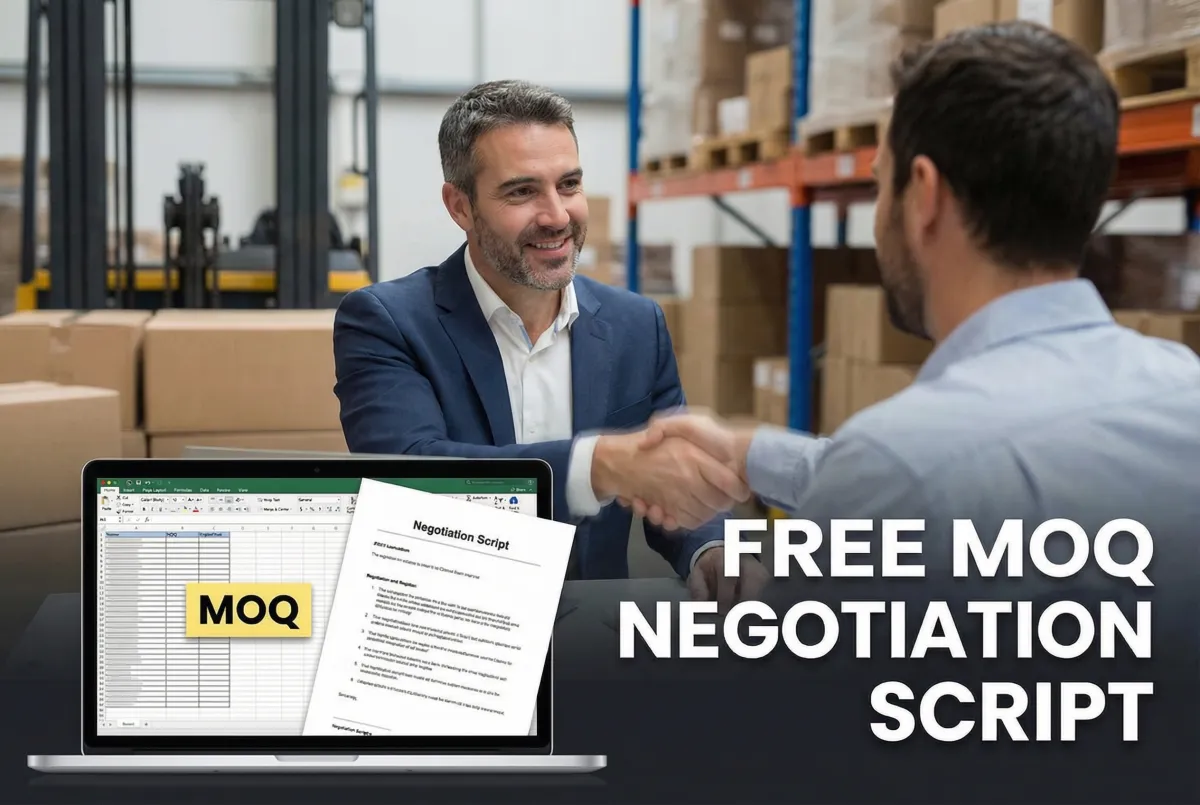
Free MOQ Negotiation Script: How to Negotiate Minimum Order Quantities, Get a Small Batch, and Avoid Costly Mistakes
Free MOQ Negotiation Script: How to Negotiate Minimum Order Quantities, Get a Small Batch, and Avoid Costly Sourcing Mistakes
If you've ever tried to source a product overseas, you've probably run into the same wall: the manufacturer gives you a minimum order quantity (MOQ) that's way higher than what you need, and suddenly your entire business plan is on hold.
The good news? MOQs are almost always negotiable.
The bad news? Most first-time buyers approach the conversation the wrong way and end up:
Overpaying
Overordering
Or getting ghosted entirely
This guide gives you the exact MOQ negotiation script and strategy you need to secure a small batch order without looking like a rookie.
What Is MOQ and Why Do Suppliers Set Minimum Order Quantities?
MOQ stands for Minimum Order Quantity. It is the lowest number of units a supplier is willing to produce or sell in a single order. For manufacturers, MOQs exist to cover setup costs, raw material purchasing, and production efficiency.
Understanding why a supplier sets their MOQ is the first step to negotiating it. When you understand their constraints, you can structure an offer that works for both sides.
Why Small Batch Manufacturing Orders Are Worth Fighting For
Starting with a small batch isn't just about saving money, it's about protecting your business. A small pilot order lets you:
Test product quality before committing to a large inventory investment
Validate market demand before scaling
Build a track record with your supplier
Reduce cash flow risk in the early stages of your product launch
The brands that scale successfully almost always start with a smart, small first order — not a warehouse full of untested inventory.
The MOQ Negotiation Script: What to Say to Get a Lower Minimum Order
Here's the approach that works. It's not about haggling. It's about framing. You want to position yourself as a serious, long-term buyer who is starting small on purpose, not out of desperation.
Step 1: Lead With the Long-Term Vision
Don't open with "can you lower the MOQ?" — that immediately signals inexperience. Instead, lead with where you're going:
"We're launching a new product line and are planning to scale to [X units] per quarter within 6 months. For our initial validation order, we'd like to start with [smaller number] units to confirm quality and market fit before placing our full ongoing orders with you."
This reframes the small batch request as a business decision, not a budget limitation.
Step 2: Offer Something in Return
Suppliers lower MOQs when there's something in it for them. Consider offering:
A higher per-unit price for the first order in exchange for a lower quantity
A signed letter of intent for a larger follow-up order
Faster payment terms (e.g., 50% upfront instead of the standard 30%)
Simplified product specs to reduce their production complexity
Step 3: Ask the Right Question
Instead of asking "can you do less?", ask:
"What would need to be true for you to accommodate an initial order of [X units]?"
This opens a problem-solving conversation rather than a negotiation standoff.
Common MOQ Negotiation Mistakes (And How to Avoid Them)
Revealing your budget too early. Let the supplier respond to your request before you start explaining what you can or can't afford.
Asking for too low without justification. Asking for 10% of a supplier's MOQ with no context will get you ignored. Always anchor your request to a logical business reason.
Only contacting one supplier. Leverage is everything. When you're negotiating with multiple suppliers simultaneously, you have real options and suppliers can sense that.
Treating it as a one-time transaction. Suppliers invest in relationships. Show them you're building something long-term and they'll be far more flexible upfront.
The Bottom Line: How to Source Products in Small Quantities
Getting a supplier to lower their MOQ isn't luck, it requires strategy. When you walk into the conversation with the right framing, a clear long-term vision, and something to offer in return, you shift the dynamic entirely.
You're no longer a small buyer asking for a favor. You're a growth-stage brand making a smart business decision. That's a very different conversation to be in.
Use this script as a starting point. Adapt it to your product, your category, and your supplier.
Remember, the goal isn't just to get a lower number. It's to start a relationship that scales.
Check out these related articles for Amazon sellers in the early stages.