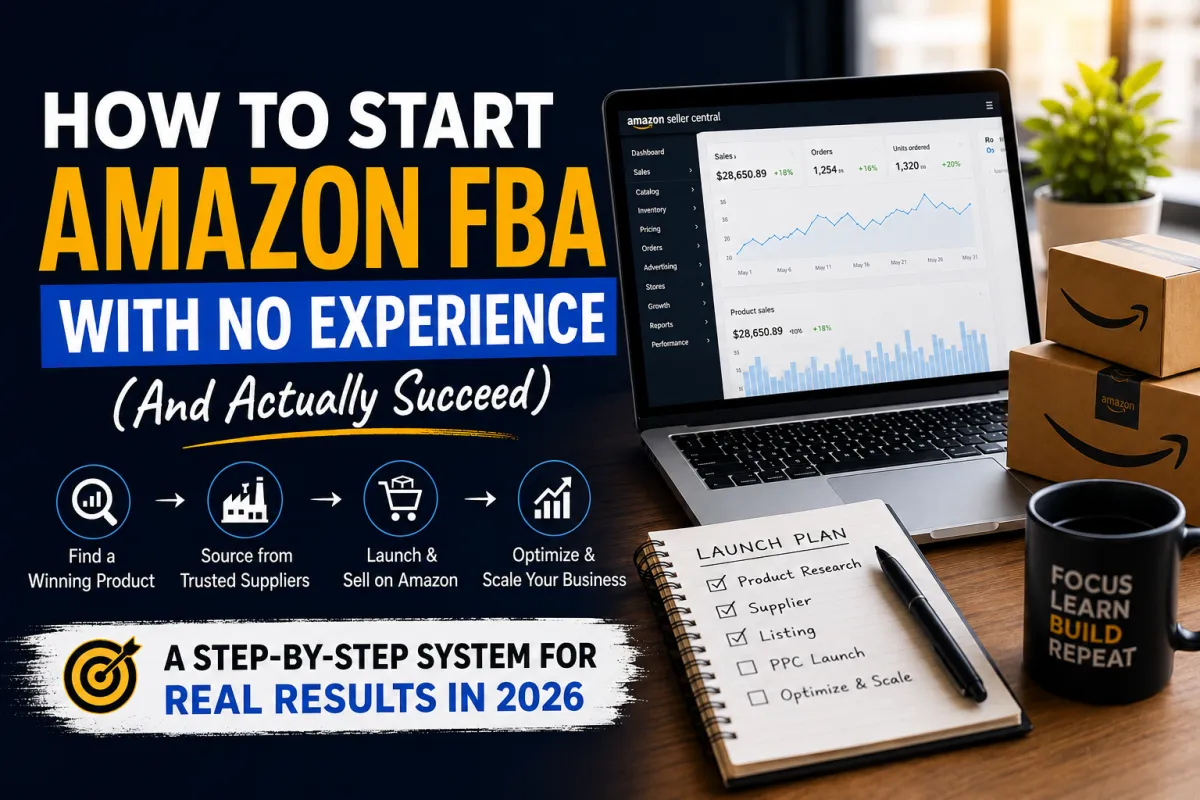
How to Start Amazon FBA With No Experience (And Actually Succeed)
How to Start Amazon FBA With No Experience (And Actually Succeed)
You've heard about Amazon FBA. Maybe you've watched the videos, read the threads, saved the posts. You know the opportunity is real. But every time you're about to take the first step, something stops you.
What if I pick the wrong product? What if I lose money? What if I don't know enough yet?
Here's the truth: nobody starts Amazon FBA knowing everything. Every successful seller you see today once had zero experience, zero sales, and zero clue what they were doing. The difference between them and everyone still sitting on the sidelines? They started anyway — with a system.
This guide gives you that system.
What Is Amazon FBA, Really?
FBA stands for Fulfillment by Amazon. The model is simple: you find a product, source it from a manufacturer, send it to Amazon's warehouse, and Amazon handles the rest — storage, shipping, customer service, and returns.
You focus on picking the right product and building your brand. Amazon handles the logistics.
That's it. No warehouse. No packing boxes at midnight. No shipping headaches.
Around 90% of serious Amazon sellers use FBA — and for good reason. It gives you access to Amazon Prime, faster delivery, and the kind of customer trust that's nearly impossible to replicate on your own. Merchize
Step 1: Shift Your Mindset First
Before you touch a spreadsheet or browse Alibaba, understand this: Amazon FBA is a real business, not a passive income hack.
The sellers who fail are usually the ones who treat it like a lottery ticket — pick a product, hope it sells, repeat. The marketplace rewards disciplined sellers more than casual experimenters. Lawrence Bros
The sellers who win treat every decision like a business owner would: with data, patience, and a long-term view.
No experience? That's actually fine. What matters more is your willingness to learn the process and follow it consistently. That's exactly what Freebirds Academy is built to teach.
Step 2: Do Your Product Research Before Anything Else
This is where most beginners go wrong. They fall in love with a product idea and run with it — no validation, no data, no margin math.
The research process has to override your personal opinion of a product. If the numbers don't work, they don't work. SellerSprout
What you're looking for in a winning product:
Consistent demand — people are searching for it year-round, not just in December
Manageable competition — not dominated by brands with 5,000+ reviews
Healthy margins — after Amazon fees, shipping, and ads, you still make money
Lightweight and durable — keeps fulfillment costs low and return rates down
Tools like Helium 10 and Jungle Scout exist specifically to help you find this data. Your title should include your primary keyword, the key benefit, and the most important product attribute — but before you even get to the listing, you need to know your product actually has demand. USA Sweet Solutions
Good product research isn't glamorous. It's the part most people skip. It's also the part that makes or breaks everything that comes after.
Step 3: Find a Supplier You Can Trust
Once you have a validated product idea, it's time to source it. For most FBA beginners, that means starting with Alibaba — the largest B2B marketplace connecting you to manufacturers, mostly in China.
A few principles to follow:
Order samples before committing — always. What looks good in photos may feel cheap in person.
Negotiate on price, not just units — many suppliers are flexible, especially for repeat orders.
Ask about customization — even small changes to packaging or color can differentiate your product.
Check certifications — depending on your category, you may need safety or compliance docs.
For a first product, 300–500 units is a test. Resist the temptation to order 2,000 units to lower your per-unit cost — if the product doesn't work, you want to learn that cheaply. SellerSprout
Start small. Validate. Then scale.
Step 4: Build a Listing That Actually Converts
Your Amazon listing is your storefront. It's what turns a browser into a buyer — and a weak listing is an invisible product no matter how good your sourcing was.
The non-negotiables:
Title: Clear, keyword-rich, and readable. Lead with what the customer is searching for.
Main image: Your main image is the biggest driver of click-through. White background, high resolution, product filling the frame. Lawrence Bros
Bullet points: Benefits first, features second. Speak to the customer's problem, not the product's specs.
Secondary images: Show the product in use. Show size context. Answer objections visually before they become reasons to bounce.
Backend keywords: Use the full character space available. Include long-tail variations and synonyms that didn't fit naturally in your copy.
One thing worth noting for 2026: Amazon's AI assistant Rufus handles hundreds of millions of daily queries. Listings optimized for natural language consistently outperform keyword-stuffed ones. Write for a real person explaining your product clearly — the algorithm rewards it. Ecomclips
Step 5: Launch With Momentum
Your listing is live. Now what?
In 2026, you can't launch on Amazon without running ads. Amazon PPC (Pay-Per-Click) is how you get visibility before you have reviews. Start with an automatic campaign — let Amazon show your product to relevant searches, collect data on what converts, then use that data to build targeted manual campaigns. Mds
Your launch goal isn't profit. It's velocity — sales, reviews, and ranking momentum. Most successful FBA sellers went through a slow, uncertain first few months. That's normal. The ones who push through that phase are the ones who build real businesses. SellerSprout
A few launch moves that work:
Run an automatic PPC campaign from day one with a modest daily budget
Use Amazon's Vine program to get your first verified reviews
Price slightly below competitors initially to win clicks over established listings
Monitor your data weekly — impressions, click-through rate, conversion rate
Step 6: Optimize, Don't Set and Forget
Once you have data coming in, your job becomes an iteration. A listing that converts at 12% can probably convert at 18% with better images. An ad campaign bleeding money might just need negative keywords added.
A clearer size chart can reduce returns. Stronger packaging can improve reviews. Better keyword targeting can lower ad waste. Lawrence Bros
This is the ongoing work of an FBA business. It's also what separates sellers who plateau at $2,000/month from those who scale to $20,000+.
The Real Reason Most People Never Start
It's not a lack of knowledge. There's more free information about Amazon FBA right now than at any point in history.
It's the gap between knowing and doing — the fear that you don't know enough yet. That you'll make a mistake. That you'll waste money.
Here's what that fear actually costs you: every month you wait is another month someone else is building the business you could have started.
More than half of new FBA sellers were profitable within their first year. That doesn't happen by accident — it happens because they followed a proven process instead of figuring it out alone. Revenue Geeks
You Don't Have to Figure This Out Alone
Freebirds Academy was built for exactly this moment — when you know Amazon FBA is the opportunity, but you need someone to walk you through it step by step, from product research to your first profitable sale.
Inside the program, you'll get:
A proven product research framework so you never guess on your first product
Supplier sourcing training so you find quality manufacturers without getting burned
Listing and PPC playbooks built for how Amazon works in 2026
A community of sellers at every stage — including those who were exactly where you are right now
The experience you need? You'll build it inside.